Oliver's Cornwall
Coast and Country
The North Coast

ON THIS PAGE

INTRODUCTION
Marsland - Morwenstow
Morwenstow - Duckpool
Duckpool - Northcott Mouth
Sandy Mouth - Crooklets
 Bude Canal, Widemouth
Bude-Crackington Haven
Crackington - High Cliff
High Cliff - Boscastle
Boscastle - Tintagel
Tintagel - Trebarwith
Trebarwith - Port Isaac
Port Isaac - Polzeath
Rumps & Lundy Bay
Polzeath to Padstow
Padstow & Stepper Point
Harlyn Bay - Trevose
Trevose - Constantine
Constantine - Porthcothan
Pothcothan - Porthmear
Bedruthan Steps
Bedruthan - Watergate Bay
Watergate Bay
Watergate to Newquay
Newquay Waterfront
 Newquay - West Pentire
West Pentire - Holywell
Holywell Revisited 2007
Holywell & Penhale Sands
 Newquay - Perranporth
Perranporth - St. Agnes
Trevellas Porth
St. Agnes - Chapel Porth
 Chapel Porth - Portreath
 Portreath to Gwithian
Portreath - Hell's Mouth
Hell's Mouth - Godrevy
Hayle Towans - St. Ives
CORNWALL REVIEWS INDEX and SITE CONTENTS
Introductory Guide
What's New?
Oliver's Cornwall Walking Pages
Homes
Gardens
Museums & Galleries
Countryside
Holy Sites & Churches
Antiquities
Castles
Towns & Villages
Miscellanea
Home Page
Contact Me
© Copyright Oliver Howes 2010
Page updated 15 August 2010


Introduction - The North Coast from the Devon Border to St. Ives

There is some wonderful walking along the northern section of the superb Cornish Coast Path.  For us it is the most accessible part as we live about midway between St. Ives and Bude.  We love the soaring cliffs, long sandy beaches, the rocky coves, surfers and wind surfers, heather and gorse, crumbling ruins of old tin mines.  Most of all we love the wonderful bracing air and the chance to see more and more of the land we love.  Deep inlets often require arduous climbs, yet there are stretches - as at Godrevy and around Treyarnon - where you can walk for miles without coming down from the clifftop.  Toughest walking on the north coast is to be found between the Devon border at Marsland Mouth and the tourist village of Tintagel.  Between Crackington Haven and Boscastle are Cornwall's highest cliffs - High Cliff rises to 731 feet.  There are also parts -such as Perranporth, Constantine, Hayle  - where the towans (dunes) behind the beach mean it is simplest and best to walk along the beach.  These walks are listed in an east to west direction and are mostly described that way.  However, many were walked in the other direction or were circular walks including an inland section.  There are a few features on locations such as The Rumps and Watergate Bay.
Godrevy Lifeguard Hut & Lighthouse
 
Return to the North Coast Contents
Return to main Coast page
Return to Home page for Cornwall Reviews Contents


Marsland Mouth to Morwenstow - Round Walk from Morwenstow

Looks idyllic doesn't it, this view of Marsland Mouth.  Believe you me, when you get down to the beach, or up on Marsland Cliff, what you see is the bleakest spot on the Cornish Coast Path.  I set off on a round walk from Morwenstow in mid-February 2005, inland first through three slurry-filled farmyards to reach Marsland Valley.  Most attractive of the farms was Marsland Manor, clearly ancient.  I had planned then to turn west to Marsland Mouth but was attracted by a sign board to detour through the woodland of Marsland Valley nature reserve into Devon and east to Gooseham Mill.  I returned at high level, still in Devon, to get this view of West Mill on the way down to the sea.  It was tough going back along the coast to Morwenstow, not just because of the four 3-400 foot climbs but also because of the wind gusting to 50 mph, fortunately coming off the sea.  But it was worth it for the views stretching, when the weather cleared enough, from Hartland Point in the north to Tintagel in the south.  Had I just followed Jarrold Pathfinder Walk 13, I would have covered about five miles.  With the nature reserve detour my total was around eight miles which included a total climb of 2000 feet.  Just six walks to go to complete the north coast from the Devon border to St. Ives!
Looking over West Mill to Marsland Mouth
OS Explorer sheet 126 
Return to the North Coast Contents
Return to main Coast page
Return to Home page for Cornwall Reviews Contents


Morwenstow & Duckpool - Round Walk from Duckpool

This was one of three that Mary and I did at the end of November 2004 - others were at Cape Cornwall and Rame Head.  All were tough in their different ways but this one was toughest of all, despite only being 7 to 8 miles.  To be fair to ourselves, the walk guide (from AA Cornwall Walks Number 1) describes it as severe and you climb at least 1500 feet in the course of it.  Conditions underfoot were muddy and this made the inland part tougher.  Regardless of all that, it was another great walk.  We set off from the car park at Duckpool along a lane to delightful Coombe village, just half-a-dozen idyllic cottages, then up through coppiced woodland to reach Woodford village.  On through the Eastaway, Stanbury and Tonacombe estates to Morwenstow.  Stanbury estate paths were difficult to find as if the farmer tries to discourage walkers.  At Morwenstow, with its lovely churchyard and memories of Parson Hawker, we joined the coast path southwards.  Two stiff descents and ascents here, not rocky but with severe gradients.  A drink along the way at the unusual Bush Inn at Morwenstow (no food that day);  Rectory Farm Tea Rooms were closed for the winter. 
OS Explorer Sheet 126
Sunset at Duckpool
Return to the North Coast Contents
Return to main Coast page
Return to Home page for Cornwall Reviews Contents


Duckpool & Northcott Mouth - Round Walk from Northcott Mouth

Jane and I did this one in January 2003, on a surprisingly warm day.  It starts and finishes at Northcott Mouth National Trust car park, a couple of miles north of Bude on the north coast.  Details in Circular Coast Walks Cornwall, published by Moor Dale and Mountain Press.  Beware, this is not for the faint-hearted;  a very steep climb up from Duckpool to the top of the cliffs felt precarious.  The walk starts with a gentle climb inland to reach Stowe Barton farm, all that remains of the Grenville's great Stowe estate.  John Grenville, Earl of Bath, built a grand new home in 1679, his daughter demolished it in 1739;  Rev. Sabine Baring-Gould ('Rock of Ages') wrote "within the memory of one man, grass grew and was mown in the meadow where sprang up Stowe House, and grew and was mown where Stowe had been".  The walk continues through delightful woodland down to the 'time-warp' village of Coombe (mostly owned by the Landmark Trust) and on to Duckpool, below radomes and satellite dishes on the cliffs above;  back along high cliffs to a steep stepped descent to Northcott Mouth.  There are amazing rock formations all along this part of the coast.  When you are down at sea level, do take a detour along the beach to see some of them;  most remarkable of all are the folded rock strata at Millook some five miles south of Bude. 
Cliffs South of Duckpool
OS Explorer Sheet 126
Return to the North Coast Contents
Return to main Coast page
Return to Home page for Cornwall Reviews Contents


Sandy Mouth to Crooklets - Round Walk from Bude

We seem to have something of a predeliction for down-market resorts like Newquay and Portreath;  so we have no trouble with starting walks at them, especially Bude where this walk started in June 2004.  Previously we have parked in the main resort but on this occasion we parked above Crooklets Beach on the north side of Bude.  As so often, we managed to park close to a perfectly acceptable café which we enjoyed at both start and finish.  The route we followed is AA Cornwall Walk Number 2.  It uses a little bit of country lane in a couple of places but is otherwise half coast, half inland paths. It is designed as a figure of eight - done as coast, inland, coast, inland - so there is a lot of variety to it. An easy 5 mile walk, except for the steep stepped descent to Northcott Mouth on the return leg.  The great attractions to this walk are the remarkable rock formations in the rugged cliffs, typical of this part of the north Cornwall coast,  and the great proliferation of wildflowers all along the cliffs.  We also enjoyed seeing all the families enjoying themselves on the beaches at Sandy Mouth and Crooklets. 
 OS Explorer Sheets 111/126 
Wildflowers and the view north from Maer Cliff
Return to the North Coast Contents
Return to main Coast page
Return to Home page for Cornwall Reviews Contents


Bude & Widemouth Bay - Round Walk from Bude using the Bude Canal

This walk is from Classic Walks Cornwall No. 57.  We have done it twice, first in 2003, again in 2004, the latter time with Mary.  In 2003 we extended it to take in Marhamchurch for lunch at the Buller's Arms.  In 2004 we stuck to the book but took a cream tea in the garden of Woodlands Tearoom at Helebridge, where the canal begins.  The walk starts in Bude, climbs gently up Efford Down to the strange 'Pepper Pot' monument whose eight sides are marked with the points of the compass - lovely views from here.  The Pepper Pot was moved in 1855, due to landslip, and now stands 7 degrees out of true.  The walk then follows the coast path south to Widemouth Bay across springy downland turf.  Widemouth is a bit of a disaster, its attractive sweep of surfing beach marred by ugly development and trailer parks.  From here the trail gently crosses fields inland to Helebridge and the excellent Wodland Tea Garden, which we often visit.  The Marhamchurch detour follows the line of the defunct part of the Bude Canal.  To return to Bude from Helebridge you simply walk the level towpath of the canal, its far side a nature reserve. Bude Canal was built in the 1820s and its two branches - to Holsworthy and Launceston - carried mineral rich sand inland to improve the poor acid soil of the farms. 
The Pepper Pot on Efford Down
 OS Explorer 111;  an easy walk
Return to the North Coast Contents
Return to main Coast page
Return to Home page for Cornwall Reviews Contents


Bude & Crackington Haven - walked in the other direction

This was a big hole in my north coast walking and, with no buses linking either Crackington Haven or halfway point Millook with Bude, the only practical way to do it occurred when Mary was with us over Easter 2005.  It was an especially fine day and Jane and our neighbour Jean fancied a day in Bude, shopping and exploring the beaches and coves.  So they dropped us at Crackington Haven and we set off on the 10 miles to Bude, well equipped with sandwiches.  A walk of contrasts, it begins with five ascents, the highest to around 500 feet at Dizzard Point, before a gentle descent to Millook Haven.  One more climb out of the haven, then relatively gentle to Widemouth Bay and 200 foot cliffs only from there to Bude.  I reckon we climbed altogether the equivalent of the highest of Lake District fells - a bit over 3000 feet.  For much of the way you are walking above 'undercliff' where massive land slips have created subsidiary slopes and cliffs.  Around Dizzard Point are some of the few trees on the north coast, a forest of dwarf sessile oaks, little bigger than bonsai size.  At Millook Haven, the rock strata in the cliffs are remarkable, folded in chevron upon chevron.  When we arrived at Widemouth Bay, another surfers paradise, families were out in force on the beach.  We reached Bude exhausted and well ready for a refreshing tea by the Bude Canal. 
OS Explorer 111.  Strenuous/moderate/easy 
Remarkable folded rock strata in cliffs at Millook
Return to the North Coast Contents
Return to main Coast page
Return to Home page for Cornwall Reviews Contents


Crackington Haven & High Cliff - Round Walk by the Ludon Valley

Mid December 2004, Jane had gone to Truro for the morning, the sun was shining and I headed off to Crackington Haven to walk the coast path to High Cliff.  There is little to Crackington Haven but a pub, a seasonal cafe and a few homes;  the main village is a mile up the hill.  I had been wanting to do this walk since learning that High Cliff, at 731 feet, is the highest in Cornwall.  There is a lot of 'down and up again' along the way, so I reckon I climbed a good 2000 feet in the two or three miles there.  The coast here has a truly wild feeling.  Cliffs are immense, with great landslips and cruel-looking rocks at their feet.  In summer it can look quite odd to see Cheviot goats and Galloway cattle grazing below on the grassy undercliff.  No woodland up here - though a grove of stunted oaks grows just above Crackington Haven -  just blackthorn, heather and gorse.  The geology is remarkable.  Rock strata, 'Crackington Shale', has been folded into chevrons in many places, as at Cambeak Head, near the Haven.  Had the day been clearer, I should have seen Pembrokeshire, some 60 miles away in Wales, from High Cliff.  As it was, the sun disappeared, the wind howled up to 50 knots and a storm approached.  I decided to return down the lovely wooded Ludon Valley.  Back at the Haven, I got refreshments at the Coombe Barton Inn, disappointingly more roadhouse than pub. 
Penkenna (or Pencannow) Point across Crackington Haven
OS Explorer 111 & NT Crackington Haven leaflet 
Return to the North Coast Contents
Return to main Coast page
Return to Home page for Cornwall Reviews Contents


High Cliff to Boscastle - Round Walk from Boscastle

The last walk of 2004 - done on New Year's Eve - and the hardest in more ways than one.  At the beginning it was hard to see Boscastle, still a long way from recovery after the dreadful August flood that destroyed buildings and swept cars and boats out to sea.  Then, once on the coast path, I found I had chosen an even tougher walk than the previous week's from Crackington Haven.  Tough maybe, but wow! the scenery.  From Boscastle Harbour, you climb a series of headlands and cliffs, each higher than the last.  As with the previous Crackington walk, altitude difference may only be 731 feet, but ups-and-downs along the way mean a total climb of at least 2000 feet.  Toughest climb of all is the last, 600 feet from above Rusey Beach up onto High Cliff.  Along the way I saw horned red cattle on cliffs by Pentargon, close to the 100 foot 'grey mare's tail' waterfall.  Weather was a mixed bag, some sun, some showers sweeping in from the sea.  Visibility was poorish:  I could see the Steeple Point GCHQ radomes and dishes only occasionally, while Lundy Island appeared only once.  I decided I couldn't cope with the five miles of coast back to Boscastle.  Instead I followed lanes and a muddy bridleway.  I am glad I did otherwise I would have missed the view in the photo.  No round walks but Collins describes this section as 'strenuous';  I agreed and was very happy to have no rock-scrambling.
South-west towards Boscastle and Tintagel from North Lodge
OS Explorer 111.  Ample parking in Boscastle. 
Return to the North Coast Contents
Return to main Coast page
Return to Home page for Cornwall Reviews Contents


Boscastle and Tintagel - using the bus one way

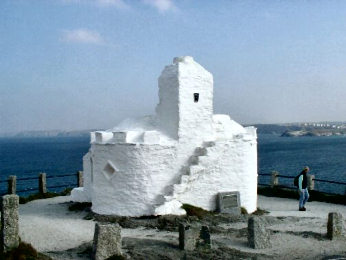
The first walk of January 2005 continued my trek along the north coast.  This time I parked at Tintagel, caught a bus to Boscastle and walked back along the coast path.  This is another of those strenuous walks made well worth the effort by both scenery and interest.  At the very start, views of the mouth of Boscastle's harbour are fascinating as you walk up onto Willapark with its Coastwatch lookout, built as a Regency summerhouse, and its iron age promontory fortifications.  Inland you look over Forrabury Stitches, a rare medieval or even Celtic field system. Past the remains of California Quarry you come to what, at sea level, would be called a 'door' in the cliff;  up here at 300 feet it is called Ladies Window (2010, I think it's gone now).  To see an unusual 'door' you need later to descend to sea level at Bossiney Haven for a view of Elephant Rock.  But before that you come first to Rocky Valley where an un-named stream tumbles over rapids and falls to the sea.  When I was there the torrential stream was meeting the crashing incoming tide. At Tintagel's Willapark (the name means field by the well) you get your first clear views of Tintagel Castle.  I finished with a welcome coffee before the fire in the Old Malthouse Inn.  Ample parking in Tintagel, even in summer;  ample parking, too, in Boscastle but busy in summer.  I used the Western Greyhound 524 bus between Tintagel and Boscastle.
Ladies Window, in the cliffs high above the sea
Collins Coast Path, OS Explorer 111
Return to the North Coast Contents
Return to main Coast page
Return to Home page for Cornwall Reviews Contents


Tintagel and Trebarwith Strand - Amazing Slate Quarries - A Round Walk
Setting off from Tintagel Castle, on a bright cold day in January 2005, I had little expectation of this walk of around five miles.  Fortunately I had with me the National Trust's Tintagel Walk Leaflet and was amazed to discover that this stretch of coastline had harboured half-a-dozen slate quarries, their workers hanging perilously from the cliffs to extract the slate, some working into the 20th century.  It must have been as hard and precarious a life working in slate quarries like this as working underground in the tin and copper mines.  At Penhallic Quarry a donkey-powered crane lowered slate to waiting ships.  Rock stacks were left as too inferior to quarry - and perhaps for fun!  Trebarwith Strand disappoints, sunless in winter and its Port William pub too expensive, especially the coffee.  I made my way back across fields to seek out 13th century Fontevrault Chapel in Tintagel's Vicarage gatehouse and the dovecote in its garden.  The more I get to know Tintagel, the more I like it, despite earlier scathing comments.  An easy walk, the ascents at each end only moderate.  There is plenty of parking in Tintagel village, varying greatly in cost.  You could also park at Trebarwith Strand to start the walk.  The climb out of Trebarwith Strand is quite steep but short.  Otherwise this 5 mile round walk is an easy one.
Rock stacks left in Lanterdan Quarry look quite castle-like
OS Explorer Sheet 111 and NT Tintagel leaflet
Return to the North Coast Contents
Return to main Coast page
Return to Home page for Cornwall Reviews Contents


Trebarwith Strand to Port Isaac

This walk, which I actually did in the right direction, from Trebarwith Strand to Port Isaac at the end of January 2005, is probably the hardest I have done yet.  Cliffs rise to 300 feet and there are five climbs from sea level along the way.  First is probably the toughest, incorporating 220 steps.  Despite the cloudy day (the photo was taken in the one brief break in the cloud) it was well worth the effort.  This part of the coast is wild and you pass only the occasional farmhouse inland - and nowhere for refreshments - in the seven miles to Port Gaverne, just short of Port Isaac.  But it doesn't feel at all inhospitable.  The great curve of coast, from Tintagel Castle to the Rumps, means that almost all the time you can see Tintagel church, and sometimes Lundy Island behind, and Port Isaac looking welcoming ahead.  There is a little industrial interest near the start of the walk:  a couple of filled-in pit shafts on Dennis Point and remains of a slate quarry at Backways Cove where, as at Lanterdan Quarry near Tintagel, a stack of poorer quality slate has been left standing.  But I was disappointed not to see the Red Devon cattle that the National Trust grazes on the cliff-top further along.  Jane dropped me off at Trebarwith Stand;  she met me five hours later in the Golden Lion in by Port Isaac harbour - an acceptable 7½ mile trek for a pensioner. 
 OS Explorer 109/OS 106   Strenuous.  Looking back to Gull Rock and Tintagel from Bounds Cliff
Return to the North Coast Contents
Return to main Coast page
Return to Home page for Cornwall Reviews Contents


Port Isaac to Polzeath - using the bus in one direction

I am probably prouder of this walk on the North Cornwall section of the coast path than any other.  A couple of years ago my sisters, Mary and Frances, did it in the Polzeath-Port Isaac direction on the way to meet up with us and friends for lunch at the Port Gaverne Hotel (excellent crab sandwiches).  At the time they felt it was too tough for me!  Feeling fit from recent strenuous north coast walking, I accepted the challenge in mid-January 2005.  As with my recent Boscastle-Timtagel walk I used Western Greyhound 524, parking on Polzeath beach and bussing to Port Isaac. Collins describes the three miles from Port Isaac to Port Quin as strenuous.  Very much so with some 650 steps to negotiate along the way.  However, having climbed out of Port Quin, the walking then seemed so easy in comparison that, instead of following my original plan of cheating by cutting off a large corner from Lundy Bay or Carnweather Point to Polzeath, I found myself carrying on by the Rumps, Pentire Point, New Polzeath and across the vast beach back to the car.  I reckon the whole walk with detours was around ten miles.  The day was fine, the views glorious.  Like the cottages in the charming little former fishing village of Port Quin, Doyden Castle - an 1830 folly built as a retreat for drinking and gambling - is now a National Trust rental cottage. 
Doyden Castle on Doyden Point, overlooking Port Isaac Bay
Ordnance Survey Explorer 106. 
Return to the North Coast Contents
Return to main Coast page
Return to Home page for Cornwall Reviews Contents


The Rumps and Lundy Bay - A Feature

On a cold but still December afternoon in 2003, I dropped Jane off at her quilting circle in Rock and headed to the coast.  I parked first in the National Trust's car park above Lundy Bay to explore a part that Jane remembers from her childhood, but I had not seen before.  On the west side of Lundy Bay is Lundy Hole where, on a rough day, the sea spouts alarmingly up through a cave-like gap in the cliff.  Like most of the north coast, the scenery is superb, views are long and the walking is moderate to tough (tougher if you continue east to Port Isaac).  I then parked in the Trust's car park at Pentireglaze to walk to the Rumps.  The Rumps is a narrow-necked rocky promontory, delineated by iron-age earth works, creating a promontory fort.  It appears to have three conical hills on it but, when you get there, you discover that the third is a separate island called the Mouls.  Later I took sunset photos from Pentire Point and New Polzeath looking across the Camel Estuary.  I returned to The Rumps on a brilliant early November 2004 day, walking from New Polzeath by way of Pentire Point.  Although there is quite a climb to Pentire Point, it is not difficult though you do feel a bit close to the edge in places.  As so often, I made a round walk of it (around 5 miles) by returning inland by Pentire Farm. 
The Rumps from near Pentire Point
 OS Explorer 106    Rumps 'Antiquities' feature
Return to the North Coast Contents
Return to main Coast page
Return to Home page for Cornwall Reviews Contents


Polzeath to Padstow
In early May 2007 I did one of my favourite North Coast walks, one I like to do regularly and can do from home with the help of a couple of buses.  Although this section is just Polzeath to Padstow, that's only an easy three mile walk plus a ferry.  So I choose to make more of a day of it.  I like to take the bus from Wadebridge to Polzeath;  walk inland by either Pentireglaze Farm or Pentire Farm to reach the coast near The Rumps;  follow the coast path by Pentire Point back to Polzeath;  continue on the coast path to Rock;  take the ferry across to Padstow and the bus home.  I can't think of a more scenic or more enjoyable walk - and its quite an easy one.  Views from The Rumps and Pentire Point are north over Port Isaac Bay to Tintagel, south across the Camel estuary to Stepper Point, Trevose Head and beyond.  Nearing Polzeath, if the tide is low, you can cross the sands and climb low cliffs on the other side.  At low tide you can walk the beach from Daymer Bay to Rock, too.  Alternatively, you can climb Brea Hill to enjoy the view from the bronze age barrows on top, or follow a path a little inland crossing the golf course to visit St. Enodoc church.  Refreshments along the way - at cafés in Polzeath and at Daymer Bay, and at the Rock Inn (good pasties) in Rock.  And Padstow is full of pubs, cafés and restaurants.
Lone Polzeath surfer with Stepper Point behind
Easy walking - beach, dumnes or golf course
Return to the North Coast Contents
Return to main Coast page
Return to Home page for Cornwall Reviews Contents


Polzeath and Daymer Bay - A Feature
This is one of our favourite short walks - only three miles there and back and only 20 minutes from our home.  Sometimes we like to park at Daymer Bay (quite close to St. Enodoc church in the dunes), other times at Polzeath, where you can park on the firm beach at low tide.  Either way we usually have a snack at one of the several cafés by the surfer's beach at Polzeath.  [Since writing that, coffee and food have generally become much more expensive at Polzeath, duw presumably to the rock effect.  It seems to me that a £2.50 coffee is London prices, not Cornwall prices]  It is an easy walk with only very moderate cliffs and a grassy track.  In summer there are two things against this walk - the sheer number of people and the fact that, so many of them being from the big city, few make eye contact, let alone exchange the usual greetings.  When we walked in early November 2003 the surf was roaring and the late low sun was creating rainbows in the spume.  Polzeath is a very popular surfing beach.  Daymer Bay is a favourite of wind and kite surfers out of season; in season it is very much a family beach.  Parking at both ends but we prefer to park at Daymer (cheap in winter) or at New Polzeath (free along the front, if you can get a space). 
Park at Daymer Bay, Polzeath or New Polzeath
Surf rolls in on a quiet day at Daymer Bay
Return to the North Coast Contents
Return to main Coast page
Return to Home page for Cornwall Reviews Contents


Padstow, Stepper Point and Trevone  - A Round Walk

You can start this walk at either Padstow or Trevone Bay.  In late December 2003 my sister Mary and I started at Trevone so as to have lunch in Padstow at two-thirds distance.  From Trevone's quiet sandy bay, we climbed steadily to the 'pepper pot' on Stepper Point, getting totally soaked by a violent December hail storm along the way.  By the time we had descended along the south bank of the Camel estuary and reached Padstow we were quite dry again.  After bacon sandwiches at the Galleon (now a café/bar) we walked up the hill to Prideaux Place, Padstow's great house, to cross the fields back to Trevone.  This is one of the easier coastal walks, its 7 miles described in OS Pathfinder Walk 10.  Views along the coast in both directions, and across the estuary, are quite wonderful.  The view in the photograph - of Stepper Point on one side of the Camel estuary and Pentire Point on the other, is one of my great favourites.  On this occasion the light was just right.  In Padstow, where parking is difficult, I suggest using the main car park by harbour;  there is free parking at Trevone out of season and an acceptable small seasonal café there.
Stepper Point and Pentire Point
OS Explorer 106
Return to the North Coast Contents
Return to main Coast page
Return to Home page for Cornwall Reviews Contents


Harlyn Bay and Trevose Head

This Coast Path walk is in our own territory, not far from Wadebridge.  My sister Mary stayed with us in October 2003.  Jane was recovering from a damaged knee - hurt while gardening of all things - but wanted to take a short easy walk as part of her rehabilation. We parked at Trevone near Padstow and Mary and I walked by Harlyn Bay and Mother Ivey's Bay to Trevose Head and then back to Harlyn Bay.  Jane walked from Trevone to Harlyn Bay and back, then drove to meet us at Harlyn on our return.  Mary and I enjoyed our longer walk, passing Rick Stein's home on our way to Trevose lighthouse and Dinas Head.  When we all met up at Harlyn Bay, we enjoyed hot sandwiches from the seasonal  mobile 'Food for Thought' snack shack there, one of the very best of the feeding stations that one finds all along the coast.  This one serves terrific hot filled rolls, very satisfying when walking, and good fresh coffee.  While eating we enjoyed watching the kite surfers who seemed, on this breezy day, to spend at least half their time in the air.  Other places for watching these surfing acrobats are Watergate Bay and Daymer Bay, the latter only out of the family vacation season.  None of the walk guides have a round walk here (nearest is one from Padstow to Stepper Point and Trevone).
Harlyn Bay in the early morning winter sun
OS Explorer 106
Return to the North Coast Contents
Return to main Coast page
Return to Home page for Cornwall Reviews Contents


Harlyn Bay, Trevose Head and Constantine

This mid December 2004 walk, on an unexpectedly gloriously sunny day, duplicates part of the previous walk.  The plan had been to park at Harlyn Bay, follow the coast round Trevose and Dinas Heads to Constantine, then cut across inland through Harlyn village to the car.  Unfortunately, Jane's back was giving trouble and she had to turn back.  I continued round to Constantine where we met up at Trevose Golf Club.  This is one of the easiest sections of coast with no rock scrambling and a climb only to around 250 feet at Trevose Head.  There is a lot of interest along the way.  Mother Ivey's Cottage was home to a tough lady who claimed all local salvage rights.  Polventon is a striking  1930 'Modern Movement' house.  Nearby, a lifeboat station is tucked below the cliffs.  On Trevose Head is a lighthouse, usually seen from much of the coast path elsewhere.  Below Dinas Head waves crash over conical rocks - the Bull and the Quies.  High above Mackerel Cove you can look down into a massive collapsed cave known as a 'blowing hole'.  Cliffs peter out by Booby's Bay and Constantine Bay;  the long sandy beach is as popular with surfers as the nearby Trevose golf course is with golfers.  We enjoyed incredibly cheap tea and coffee in the clubhouse - food prices look good, too.
Trevose Lighthouse seen from Dinas Head
OS Explorer sheet 106
Return to the North Coast Contents
Return to main Coast page
Return to Home page for Cornwall Reviews Contents


Constantine to Porthcothan - Round Walk from Constantine

Late September 2004, Mary had gone back to Cirencester, and we planned a longish walk of our own on the north coast.  We had meant to start from Porthcothan and walk to Trevose Head.  In the event, we felt that the Council was being greedy, asking for £3.50 to park there for five hours (2010, it's even pricier now), so we parked instead at Constantine, close to Trevose Golf Club.  A parabolic route inland brought us eventually to Carnevas Farm, a holiday rental complex, then a minor road took us down to Porthcothan Beach.  So far, so pleasant but the real joy was yet to come - the Cornish Coast Path taking us back north to Constantine Bay.  Just under four miles, this is one of the easiest walks on the north coast.  Cliffs are only 100 feet high and, once you have climbed gently up the path above Porthcothan Beach, it is generally level going all the way.  Surf was crashing into a succession of small rocky coves along the way and, though the tide was receeding by the time we reached Treyarnon Bay and Constantine Bay, the rollers were still about six feet.  Views south-west were to Godrevy Point, north to Trevose Head.  We took sandwiches but food is available in the pub at Porthcothan, in Constantine and seasonally at the Treyarnon Bay snack shack and YHA.  We then walked over the golf course to find the ruins of St. Constantine's Well, though we had then yet to find his church. 
 Surf-guard's Inshore Lifeboat in Treyarnon Bay
OS Explorer 106.  Figure out your own inland paths. 
Return to the North Coast Contents
Return to main Coast page
Return to Home page for Cornwall Reviews Contents


Porthcothan and Porth Mear - round walk from from Pentire Farm

In April 2005 I took advantage of an unexpectedly warm and sunny day to fill in the last two little gaps in the Coast Path between the Devon border and Godrevy.  In the morning I did this short section between Porth Mear and Porthcothan.  (After lunch at the Bowgie Inn I walked to Newquay).  I had planned to park in Porthcothan but changed my mind when I saw the parking charges;  £3 for the hour that was all I needed didn't appeal so, not for the first time, North Cornwall District Council missed out on my money altogether.  Why on earth do they price themselves out of business out of season?  Instead I drove towards Bedruthan Steps and found a grassy National Trust car park (free) by Pentire Farm.  As a result my walk was a little longer than planned but my enjoyment was added to by the pleasure of walking down through a large meadow and a National Trust nature reserve with lovely views of Porth Mear - or Porth Meor on some signs and maps.  April is the beginning of the wild flower season and the coast path was a mass of colour and the furze and blackthorn were both out.  As along much of this coast, massive rocks and small islands rise from the sea, a very dangerous coast for shipping still.  Porthcothan  is a bit depressing, all bungalows with square dormers and 'picture windows'
OS Explorer sheet 106.  Easy walking. 
Porthcothan Bay
Return to the North Coast Contents
Return to main Coast page
Return to Home page for Cornwall Reviews Contents


Porth Mear to Bedruthan Steps - Out and Back from Carnewas

This landscape became famous when Victorian holiday-makers came to admire the 300 foot cliffs and gave names to the rock islands that project above the long sandy beach at Carnewas, names like Samaritan Island and Queen Bess Rock, although the latter has since lost her head.  We took advantage of sun on the first cold day of mid-November 2004 to park in the National Trust car park at Carnewas and walk most of the way north to Porthcothan.  The sweep of beach is wonderful, the cliffs impressive and the walking mainly level and easy.  Mostly the path follows beautifully made Cornish hedges, their stone laid in herringbone pattern;  they are a riot of wildflowers in summer.  Halfway along we detoured on to Park Head to identify the remains of an iron age rampart.  We were encouraged to do this walk by AA Cornwall Walks number 22;  this has an inland loop at the Porthcothan end but we preferred to return along the cliffs.  The National Trust has a summer shop at Carnewas and we enjoyed lunch at the tea room there, open every day in summer, weekends in winter.  Steps down to the beach are open in summer;  otherwise it's a scramble down ancient and rather difficult paths.
Bedruthan Steps
On OS Explorer sheet 106
Return to the North Coast Contents
Return to main Coast page
Return to Home page for Cornwall Reviews Contents


Bedruthan Steps to Watergate Bay - Out and Back from Carnewas

Another north coast walk done in February 2005 and very enjoyable, too.  As there is no practical way of doing this section as a round walk, and as there are no connecting buses, I parked in the National Trust car park at Carnewas above Bedruthan Steps and did it as an out-and-back.  After my recent exertions further north I was quite glad that this is a relatively easy and relaxing eight mile walk.  The substantial ascents to around 300 feet out of Mawgan Porth in each direction are long but easy going both ways.  Views are not as long as some north coast walks - to Trevose Light in the north, to West Pentire, just beyond Newquay, in the south.  I liked Mawgan Porth, a large sheltered cove with glorious sands.  It's a fairly down-market family resort, and suffers from too much post-war development, but manages to be quiet and attractive in winter.  In both directions I stopped for coffee in the Merrymoor Inn there and, from the look of the menu, would happily lunch there.  No industrial remains on this walk - the slate quarries are up-coast, the tin mines down-coast - but I was delighted to see the iron age promontory fort (pictured) at Griffin's Point;  clearly much of it has been eroded into the sea.  By the time I got to Watergate Bay, the tide was well out and the vast expanse of sand almost empty of people;  those few there were looked tiny from the heights of the cliffs. 
Iron Age Promontory Fort at Griffin's Point
On OS Explorer sheet 106 
The Merrymoor Inn, Mawgan PorthOne of our favourite short walks is from St. Mawgan to Mawgan Porth and back.  We did this in late May 2008 after taking a friend to Newquay airport.  We lunched at the Merrymoor on superb crisp hot well-filled baguettes - bacon, brie and cranberry and mediterranean vegetable.  Good coffee at £1 per cup!  It may not be elegant but it's family owned and great value.
Return to the North Coast Contents
Return to main Coast page
Return to Home page for Cornwall Reviews Contents


Watergate Bay - A Feature
We return time and again to Watergate Bay, just to the north of Newquay on the north coast.  We park near the Watergate Bay Hotel.  Sometimes we walk the three miles of firm golden sands, sometimes we walk the coast path to Newquay, sometimes we just enjoy the rugged and highly colourful cliffs, the surf and the surfers.  Facilities are good.  Watergate Bay Hotel is a good, slightly old fashioned hotel with an indoor pool and is very popular with families.  The Extreme Academy is an admired surf school.  Attached to it is Jamie Oliver's Fifteen restaurant, below it the good quality Beach Hut bar and café and a seasonal takeaway.  There were other hotels at Watergate Bay but they have been replaced by holiday apartment blocks.  The main car park is directly above the Beach Hut;  there is more in a field behind.  Newquay Airport - with flights from London Gatwick and Stansted and several flights daily to the Isles of Scilly - is just two miles away.  While you can approach Watergate Bay from the A39 at St. Columb, it is far more scenic to tale the coast road from Padstow.
Watergate Bay from above Fruitful Cove
Beware!  Parking at Watergate Bay has now (2008) become expensive, even in the grassy car park across the road.
Return to the North Coast Contents
Return to main Coast page
Return to Home page for Cornwall Reviews Contents


Watergate Bay to Newquay
It was only when I walked from Watergate Bay to Newquay and back in April 2007 that I realised that, although I had done this walk several times in the past, I had never posted a report and photos of this section of the Cornish Coast Path.  So here goes.  This is one of the easier coastal walks - yet one of the most scenic.  Nowhere do you get up above around 150 feet and the steepest climb is the moderate one out of Watergate Bay.  I didn't actually make that climb;  Restormel Council parking is now an extortionate £7 per day - so I found a handy free layby higher up.  Views are superb, taking in the full sweep of the bay from Griffin's Point to Towan Head, extending north to Park Head, and south to St. Ives.  Interest along the way is considerable.  The reason for my walk was to look at the bronze age barrows above Fruitful Cove and the iron age promontory fort on Trevelgue Head.  But I also found a plaque above Lusty Glaze beach about the former Edyvean Canal and another on Barrowfields about the many bronze age barrows destroyed by a stone-seeking farmer, leaving only a couple.  Biggest surprise was on Great Western beach where I found a well constructed tunnel running 30 yards into the cliff with fairly modern lift doors at the end but no call button!
Porth Beach and Trevelgue Head
If not a VW Camper freak, avoid Run to the Sun, late May bank holiday.
Return to the North Coast Contents
Return to main Coast page
Return to Home page for Cornwall Reviews Contents


Newquay Waterfront Walk - Out and Back from Towan Head
Learning of a Newquay Discovery Trail - leaflet available from the TIC - my sister Mary and I decided to make it the basis for a walk of our own.  We parked above the southern end of Fistral Beach - away from the tawdry town - and walked the waterfront by cliff and beach from surfers paradise Fistral Bay in the south to ancient Barrowfields (a former bronze-age burial site) to the north.  The walk took us past the old Lifeboat Station, the Coastguard lookout, the Huer's Hut from which shoals of pilchards were spotted, past the hidden harbour, past the Island - where a house is reached by its own suspension bridge - and along lovely sandy beaches - coves at high tide, a great three mile sweep of sand at low tide.  Depending on the state of the tide, you may have to include some of the town in this walk but none of the worst of it.  And, if you do have to include some of the town, you will probably find yourself on the route of the railway that J. T. Treffry built;  in the harbour, look out for the tunnel from which the railway emerged to terminate on the now stranded pier in the harbour.  This makes superb easy walking with lots of interest and some wonderful views.  Our preferred eating place is the conservatory like café in the Headland Hotel with its sea views but Fistral Blu is good, too and has views of Fistral beach.
 When parking in Newquay beware of over-zealous clampers.
 The Huer's Hut in Newquay
Return to the North Coast Contents
Return to main Coast page
Return to Home page for Cornwall Reviews Contents


Newquay to West Pentire - Out and Back from the Bowgie Inn

In mid-April 2005 I took advantage of an unexpectedly warm and sunny day to fill in the last two little gaps in the Coast Path between the Devon border and Godrevy.  In the morning I did Porth Mear to Porthcothan.  After lunch at the Bowgie Inn at West Pentire, I walked to Newquay. This is one of the very few sections of the coast path where the signage is poor in places.  When I came to the sand dunes behind vast sandy Crantock Beach, signs disappeared completely.  As the tide was well out, and looked like staying that way for some time, I decided to drop down to the beach and walk up the sandy west bank of the little River Gannel.  I was glad I did.  The sand was generally firm and easy to walk and I saw much that I would have missed on the path - big houses on the East Pentire bank with gardens seeming to drop almost vertically to the river, an attractive ferry station (more of that later) and the skeleton of a wooden hulled boat, left to rot.  Once over the footbridge, I walked up through Pentire to Fistral Beach.  On my way back I managed to find the official Crantock path, through woodland to the dunes.  Crossing the Gannel needs thought.  The bridge is covered at high tide.  A ferry operates but only in the summer.  If you do as I did and walk up the Gannel, remember that the tide comes in very fast!
OS Explorer sheet 104.  An easy section.
Narrow wooden bridge over the Gannel from Penpol and Pentire
Return to the North Coast Contents
Return to main Coast page
Return to Home page for Cornwall Reviews Contents


West Pentire and Holywell Bay - Round Walk from Bowgie Inn

This is one of the truly great coast path round-walks.  I did it three times during winter 2002/3, first with Jane, then with sister Mary, finally with sister Frances - all agree that, with good weather and the right surf conditions, this makes an unbeatable two hours.  My view of a great walk is that it should fulfil five conditions - glorious scenery, not too difficult, safe car parking, coffee at start, lunch at finish. This one meets the specification.  You will find details in Jarrold Pathfinder Guide Walk 3.  Park below the Bowgie Inn in West Pentire village, south-west of Newquay.  The walk drops inland into a hidden valley, climbs pasture towards the coast, crosses sand dunes to Holywell Bay, then follows the cliff-top around high headlands with vast coastal views, returning finally to West Pentire.  The Bowgie Inn  (the name means cow-shed) has good soups, service and views - but gets very busy in summer.   If you use the public car park, beware clampers - the same applies all around Newquay, where we got caught for a £60 fine while lunching at Fistral Blu.
Jane enjoys the view from Kelsey Head north across Porth Joke
OS Explorer 104.    Holywell revisited 2007
Return to the North Coast Contents
Return to main Coast page
Return to Home page for Cornwall Reviews Contents


Holywell Bay Revisited in September 2007
I have walked at Holywell Bay many times, with Jane, with sisters Mary and Frances and with Craig.  I never tire of the beauty of the walk taking in the bay, the dunes and Pentire Point West.  But each time before I have parked at West Pentire, an expensive business.  This time, in September 2007, I wanted to spend more time in both Holywell and around the beach, so I parked in the National Trust car park on the lane to Penhale Camp.  I covered 2 miles along the beach and back and then took the coast path to West Pentire.  From there I returned to Holywell by way of Treago Mill, Lewannick (I believe there is a right of way through), Trevornick, then Ellenglaze and down the valley.  Apart from the sheer pleasure of the walk - about 8 miles in all - I also wanted to see the cliff castle on Kelsey Head, the holy well on Trevornick golf course and the cave with a spring at the northern end of Holywell beach.  I didn't find the latter on this occasion.  I was quite impressed by the two holiday parks, Trevornick with fishing lakes and golf course, Holywell Bay with a small supermarket.  There are two pubs in Holywell, Treguth Inn in the village, St. Piran's above the beach.  I returned later for a round walk over Penhale Sands and was successful in finding the remarkable cave with the spring.
Holywell Bay, Gull (or Carter's) Rocks
OS Explorer 104. 
Walked yet again at the end of September 2007 with my sister Frances.  I showed her the two holy wells, we had coffee at the Bowgie Inn and lunch at St. Piran's Inn - not our kind of place but we enjoyed our hot baguettes.  We then climbed Penhale Point.
Return to West Pentire and Holywell Bay
Return to the North Coast Contents
Return to main Coast page
Return to Home page for Cornwall Reviews Contents


Holywell, Perran Beach and Penhale Sands
September 2007 and, with the weather still holding and the day glorious, I took another walk from the National Trust car park at Holywell Bay.  This time I headed south, following the coast path by way of Penhale Point and Ligger Point to halfway along Perran Beach.  There a path (shown on OS104 but in no way distinct) leads up onto Penhale Sands.  To make a circular walk of it I then took the road to Mount and then a field path that leads to woodland and down the valley by way of Ellenglaze and so back to Holywell Bay.  I must have done about 8 miles in all.  This is an odd walk but not without interest.  On Penhale Point there are skeletal remains of a cliff castle.  Inland from the coast path, from Penhale Point to Ligger Point, is Penhale Camp, a TA training ground.  It stands on the site of an old mine and the ground is littered with mining spoil.  The view along Perran Beach - to Perranporth, St. Agnes Head and St. Ives - is superb.  Take a compass to cross Penhale Sands.  There is no one clear path and you could get lost in the dunes.  From the map you would think you could wander freely on Penhale Sands but 60% is occupied by the army training ground, 20% by holiday parks, so access is very restricted - a great shame.  Back at Holywell Bay I was lucky enough to be shown the holy well cave by Mike from the NT car park.
Looking south across Perran Beach
Of course, St. Piran's Oratory and Church are on Penhale Sands
Return to the North Coast Contents
Return to main Coast page
Return to Home page for Cornwall Reviews Contents


West Pentire to Perranporth - Walked from Perranporth

My old school friend Craig, who in the past has done Wainwright's tough coast-to-coast from St. Bees to Abbs Head, was over from New York and fancied a bracing coast walk.  He had once joined a group coast path walk in Cornwall and had the misfortune to fall down a cliff;  this time he made it intact, happily!  Jane, who was still suffering from a bad knee,  left us at Perranporth and met us near Newquay for lunch at the Bowgie Inn.   The walk starts with a two mile trek across Perranporth sands before climbing up onto the cliffs;  this is far and away the toughest part of the walk (beach walking can be hard) and can't really be avoided because of the holiday parks above.  Passing Penhale military camp, a strange radar array stands on the clifftop above Hoblyn's Cove.  Above lovely Holywell Beach there are massive sand dunes.  For variation, you could take an inland toute from there to West Pentire (see West Pentire and Holywell Bay above) but I think the coast path here is too glorious to miss.  The Gannel and Crantock Beach can be crossed on foot at low tide or by small ferry in summer.  A 7 mile one way walk. 
A storm approaches over Bowden Rocks
OS Explorer Sheet 104
Return to the North Coast Contents
Return to main Coast page
Return to Home page for Cornwall Reviews Contents


Perranporth to St. Agnes - Walked from St. Agnes
Another wonderful late October day in 2003 - mid 50s temperatures, sunny, breezy - when sister Frances and I parked at the top of  St. Agnes village, walked down to Trevaunance Cove and took the cliff path north towards Perranporth.  Despite 300 foot cliffs at Cligga Head, the walk is not difficult but, if it were, it would be worth it for the glorious views, colourful cliffs and mine ruins.  Collins Walk the Cornish Coast Path section 19 covers the walk of about four coast miles each way.  If you have time, explore the art and craft galleries in both St. Agnes and Trevaunance Cove;  enjoy the superb surfing beach and the unusual millennium sundial at Perranporth.  You could eat at the beach cafe there but better at Driftwood Spars in Trevaunance Cove. 

 Trevaunance Cove from the ruined harbour wall
Millennium Sundial above Perranporth beach
Return to the North Coast Contents
Return to main Coast page
Return to Home page for Cornwall Reviews Contents


Trevellas Porth and Trevellas Coombe - a feature
The photo on the left suggests a quiet little cove.  So it is now, but a century or so ago this was a site of frenzied mining activity, engine houses and other mine buildings stretching back up the valley towards the little village of Mithian.  Now a few cars may find their way down to the porth and a few walkers pass on their trek along the Cornish Coast Path.  Any activity now is in adjacent Trevaunance Cove, the beach for St. Agnes.
I was persuaded to park at Trevellas Porth (in August 2006) after learning that it was one of the locations used in the TV version of the Poldark novels.  I decided to take an inland walk to find the birthplace of John Opie, famous 18th century portrait painter, and for a snack in the promising Miners Arms in Mithian, the village that provided the labour force for the successful Blue Hills mine in Trevellas Coombe.  As usual, no footpaths were signed and, as so often, I lost my way badly in one place.  It's high time Cornwall Council fulfilled its obligations on path signage.  Back in Trevellas Coombe, I spent some time wandering around taking photos - there are considerable mine remains - and discovered that there is still a Blue Hills mine, albeit a small one, where the Wills family smelt their own tin to produce attractive jewellery and small giftware. 
Trevaunance Cove from Trevellas Porth
On OS104, Redruth and St. Agnes
Return to the North Coast Contents
Return to main Coast page
Return to Home page for Cornwall Reviews Contents


St. Agnes - The Beacon, The Head and Chapel Porth - Round Walk
Another glorious coast path walk, this one on the north coast around the small town of St. Agnes, on a  lovely sunny day with distant haze.  We started from the National Trust car park at Chapel Porth, walked inland up the valley and over the 629 foot Beacon to St. Agnes Head.  Back along 300 foot cliffs, past Wheal Coates mine ruins, to Chapel Porth where we enjoyed great hot bacon and mushroom garlic baguettes at the excellent Beach Cafe.  St. Agnes itself is full of art galleries and craft shops.  Preferred eating place is Driftwood Spars Inn down by Trevaunance Cove.  St. Agnes Hotel in the village is also OK.  Walk from AA Cornwall Walks, number 31.  I did this later with Mary and Frances, extended to 8 miles to include Trevaunance Cove at both ends;  I had to admit to weariness after climbing quaint Stippy Stappy on the way back up to the car park at the top of the village.   I did this walk again in May 2008, partly to check out what was happening with the excellent Chapel Porth Beach Café which had burned down in 2007.  Rebuilding work was not yet complete but I was delighted to find that the café was operating from a converted container in the car park.  Despite difficulties, the full normal menu was offered, including the superb hot baguettes and the famous hedgehog ice cream.
On OS Explorer Sheet 104
Towanroath Engine House
Return to the North Coast Contents
Return to main Coast page
Return to Home page for Cornwall Reviews Contents


Chapel Porth to Portreath to via Porthtowan - Out and Back

I was especially pleased to do this walk with my sister Mary during her visit at Easter 2005.  Along with our Crackington Haven to Bude walk, this filled a substantial gap in my north coast odyssey, now complete from Hayle to the Devon border.  We parked in the National Trust car park at Chapel Porth, a couple of miles from St. Agnes village to do the walk to Portreath and back.  If the footpath signs are to be believed, we did an 11 mile 'out-and-back' walk.  Collins describes this section as 'moderate' but the four climbs in each direction qualified it in our minds as at least 'stiff'.  As so often on the north coast, there is a lot of interest along the way, here described from Portreath to Chapel Porth.  Portreath is down-market vacation oriented village with a long harbour, good surfing and a child-friendly beach.  Between there and Porthtowan you follow the perimeter fence of a wartime airfield, unused but closed off for security reasons.  Just before Porthtowan an unusual square stone structure conceals the shaft of a disused mine.  Porthtowan is surfer territory, with rental apartmernts, surf hire and a bar which is the parent of the excellent Blue South in Falmouth.  Approaching Chapel Porth - superb beach cafe - views are of Wheal Coates mine and Towanroath engine house. 
OS Expl;orer 104.  Moderate but 2 steep step flights. 
Looking towards Portreath from Mulgram Hill
Return to the North Coast Contents
Return to main Coast page
Return to Home page for Cornwall Reviews Contents


Portreath to Gwithian - using the Tehidy Trail part way
This walk, done in September 2007, had three purposes.  The first and most obvious was to revisit this part of the coast on a lovely warm sunny day.  The second was to walk in Tehidy Country Park to see how the trails there had been upgraded.  The third was to see what progress had been made with re-opening the Portreath Incline as part of the Portreath Branchline Trail, itself part of the 2008 Mineral Tramways Project.  So I parked in the lower National Trust car park at Godrevy, walked in to Gwithian and caught the 501 bus to Portreath to begin my walk proper.  The Portreath Incline was not yet open so I continued on the road beneath the Incline bridge to take a path uphill to Feadon Farm.  Once through the farm I found a crew working on the Tehidy Trail from where it joins the Portreath Branchline Trail;  my impression was that the Incline comes next and soon (2010, it won't open).  I found the Tehidy Trail complete through the park and made fast progress through pleasant woodland to Coombe.  From there I took a field path to join the Coast Path at Reskajeage to walk by Hell's Mouth, Navax Point and Godrevy Point back to the car.  I stopped at the Hell's Mouth café and was disappointed to find it had gone upmarket.  About 10 miles in all, including the initial mile into Gwithian.
Portreath harbour in water, an unusual sight
On OS Explorer 104/102 
Return to the North Coast Contents
Return to main Coast page
Return to Home page for Cornwall Reviews Contents


Portreath to Hell's Mouth - Out and Back from Portreath

Jane and I had previously walked from Godrevy to Hell's Mouth so when my sister Mary visited in September 2004 we decided to complete that section of coast by doing a return walk from Portreath to Hell's Mouth.  The day was not especially kind, mostly cloudy so nothing much in the way of pictures.  However, I did manage to get what I have wanted for some time, a picture of low gorse and heather on the clifftop.  (We must go back to Gwennap Head in West Penwith in the sun;  there the gorse and heather are prolific but, thanks to the windswept situation, only about three inches high)  For our Portreath and Hell's Mouth walk we parked in Portreath, above the excellent small family beach.  The return walk was about ten miles and the first couple of miles out of Portreath were sufficiently tough that we decided to use the road for that section on the way back.  We were glad we did.  The annual Cornish Riviera Run, organised by the MG Car Club, was passing, 100 and more classic MGs and Jaguars, all giving us a wide berth, all waving happily.  What a joy to encounter happy motorists!  We lunched at the café above Hell's Mouth on bacon and egg baps, good walking food.  There are also several places to eat in Portreath;  we prefer the 'greasy spoon' on a terrace above the beach.  We are taken with Portreath, down market but fascinating, and I have posted an item on the village and its history. 
Colourful heather and gorse high on the cliffs near Portreath
OS Explorer sheet 104 
Since 2004 the Hell's Mouth café has gone a bit upmarket and we ike it less than we once did.  Not really for walkers now.
Return to the North Coast Contents
Return to main Coast page
Return to Home page for Cornwall Reviews Contents


 Hell's Mouth and Hayle Towans - Round Walk from Godrevy

Considering the impressive cliffs around Godrevy Point and Navax Point, this is a surprisingly easy walk.  Starting from sea level at the National Trust's first Godrevy car park of three, it takes some two miles before you reach 250 feet at Navax Point - and not once do you have to descend to sea level as so often on both coasts.  Classic Walks Cornwall suggests a round walk with a one mile return on the road from Hell's Mouth.  However the road is busy and the walk so easy that we prefer to do six miles by returning along the coast.  When we did the walk in early July 2004, we found the going so easy that we then did another three or four miles - along firm golden sands towards Hayle, then back over the Towans (Cornish for sand dunes).  For much of the route you have a view of Godrevy Lighthouse on its island, the inspiration for Virginia Woolf's  'To the Lighthouse'.  She spent holidays at Talland House in St. Ives from which she could see the lighthouse.  Our preferred spot for refreshments is the Godrevy Café in the first National Trust car park; we and my sister Mary were well pleased with it in March 2008.  We used to like the Hell's Mouth cafe - simple inexpensive food - but are less keen on it now it has gone more upmarket, not really for walkers now.
  OS Explorer 102
Surfers cross the beach at Gwithian
Return to the North Coast Contents
Return to main Coast page
Return to Home page for Cornwall Reviews Contents


Hayle Towans to St. Ives - described from St. Ives to Hayle

This is actually a combination of several walks that Jane and I have done around St. Ives and Hayle but walking the section between St. Ives and Lelant Saltings in May 2005 prompted me to add them all together as one.  We used the train one way between Lelant Saltings and St. Ives.  The full walk, from Hayle Towans to St. Ives would be around seven miles;  buses run between the two towns.  Looking at a map, you might think this was a largely urban walk.  It is quite a surprise to find just how rural and coastal much feels.  St. Ives station is just above Porthminster beach, from which the path climbs Porthminster Point to a 'Huer's Hut' (see Newquay).  It then follows lanes lined with impressive homes to Carbis Bay (of no interest) and on to the dunes and golf course above Porth Kidney Sands.  Views are now along four miles of sands to Godrevy lighthouse.  When you come to the church at the exit from the golf course, don't take the signed path but bear left down a narrow lane that eventually passes Lelant Saltings station and brings you out on a road under the railway to Griggs Quay.  The pub here is much better than it looks and we can recommended it.  From here it's mostly road until you follow the far side of the harbour out to Hayle Towans for more glorious views. 
Hayle Towans and Beach, Godrevy Lighthouse on the horizon
On OS Explorer Sheet 102.  Easy walking. 
Return to the North Coast Contents
Return to main Coast page
Return to Home page for Cornwall Reviews Contents
CORNWALL REVIEWS INDEX and SITE CONTENTS
Introductory Guide
What's New?
Oliver's Cornwall Walking Pages
Homes
Gardens
Museums & Galleries
Countryside
Holy Sites & Churches
Antiquities
Castles
Towns & Villages
Miscellanea
Home Page
Contact Me
© Copyright Oliver Howes 2010
Page updated 15 August 2010


Free Web Counter