Oliver's Cornwall
Coast and Country
The Far West
This is the far western coastline, described counter-clockwise, St. Ives to Penzance.  For walkers this may be the most difficult part of the coast with some serious rock scrambling in places.  There is vast interest for mining and antiquity enthusiasts, and glorious scenery.

ON THIS PAGE
INTRODUCTION
St. Ives and Hor Point
Hor Point and Zennor
Zennor & Gurnards Head
Gurnards Head and Bosigran Castle
 Bosigran & Morvah
Morvah and Pendeen Watch
Pendeen Watch & Cape Cornwall
Explore Cape Cornwall
Priest's Cove
Cape Cornwall to Sennen
 Porth Nanven
Sennen to Land's End
Land's End to Porthgwarra
Gwennap Head & Porthcurno
Porthcurno & Penberth
Treen, Penberth & St. Loy'sCove
Boskenna & Lamorna
Lamorna & Mousehole
Mousehole & Penzance

REVIEWS INDEX and SITE CONTENTS

Recent Reviews
Homes
Gardens
Museums & Galleries
Coast & Country
Holy Sites & Churches
Antiquities
Castles
Towns & Villages
Miscellanea
Pubs
Scilly
Devon
Introductory Guide
Home Page
Contact Me
© Copyright Oliver Howes 2088 
Return to main Coast Page
Page updated 29 Febuary 2008


INTRODUCTION to West Penwith

This is that magical part of Cornwall beyond St. Ives and Penzance and known as West Penwith.  Cornwall, almost completely separated from Devon (and therefore England) by the River Tamar, is a peninsula in itself.  West Penwith is the final peninsula, only four miles of land between Hayle and Marazion joining it to the rest of Cornwall.  It looks and feels like a different world thanks to its strange juxtaposition of the relics of three widely separated historical periods.  The prehistoric age has left behind stone circles, ancient graves, standing stones and village remains.  The early Christian era is represented by Cornish crosses, chapel remains and holy wells.  The early industrial period has left the most obvious relics:  the engine houses and mine chimneys of the age of tin and copper, at its height in the 18th and 19th centuries.  Inland rises to around 700 feet with tiny fields with stone walls grazed by cattle and sheep.  Along the coast rugged cliffs rise to some 300 feet.  There are sheltered fishing coves in the south, few in the north.  The coast path is some of the most enjoyable but also some of the most difficult in places.  The path is not always clear and you may find yourself scrambling over great rocks.  Don't let that deter you, the scenery is fantastic. 
Looking south from near the National Trust's Levant Mine
Descriptions run from St. Ives, round Land's End, and on to Penzance
Return to The Far West
Return to Coast and Countryside
Return to Reviews Contents


St. Ives and Hor Point - A Short Out-and-Back Walk

In September 2004 sister Mary and I had done a fairly long - and often difficult - round walk from Zennor to Hor Point along the coast, returning inland along the Tinner's Trail.  That left an odd little 2 mile gap between St. Ives and Hor Point which I filled in on a glorious sunny day in late October 2005.  At that time of year parking is easier in St. Ives, so I used the Barnoon car park behind the Tate Gallery.  If you use that car park and you are going into St. Ives, the back streets which lead down to the Barbara Hepworth Museum and the western end of Fore Street are quite delightful and should not be missed. 
I lingered considerably on this walk, especially at the St. Ives end where the views over Porthmeor beach - the surfing beach - and the 'Island', and beyond to St. Ives Bay, Godrevy Point and Godrevy Lighthouse, are an absolute delight. 
When I reached Hor Point I was surprised to find remains of an old mine shaft on the edge of the cliff.  I hadn't known that there were mines that close to St. Ives.  Views from here are grand, too, looking back east as far as Clodgy Point. Back in St. Ives I wandered around the town, enjoyed a pasty on the waterfront and visited St. Ia's Church
Ordnance Survey Explorer 102.  An easy walk. 
Porthmeor Beach and The Island from Man's Head
Return to The Far West
Return to Coast and Countryside
Return to Reviews Contents


Hor Point to Zennor - Round Walk from Zennor

My sister Mary came down for a few days in mid-September 2004.  As always, this was a good excuse for some concentrated walking.  We took her on our South Caradon walk, on a new walk from Portreath and also to Ilfracombe in Devon.  Mary and I also did the Great Flat Lode walk and tried this one from Zennor in far West Penwith.  As a nine mile round walk, coast and inland, this was one of the hardest.  We parked in Zennor village and took the coast path to Hellesveor Cliffs, most of the way to St. Ives.  This is tough coast path with several steep ascents and descents and a fair amount of rock scrambling - in places it is even unclear exactly where the path goes.  The inland return is gentle enough but tired legs made heavy going of the multitude of tall Cornish granite stiles.  Nor was the inland path (called the 'Tinners Way' by the guide but really known as the 'Coffin Path') particularly easy to follow;  some farmers had marked the way clearly enough, others preferred to make life difficult.  We had a great walk of around five hours and afterwards collapsed into the Tinners Arms in Zennor village to linger over an excellent cream tea.  The Jarrold Pathfinder guide offers this as nine miles with the option of a shorter six miles.  It also describes it as inland out, coast back but we prefer the other way round, doing the difficult cliffs first, the easier and more level fields on the return. 
Looking north-east along the clifs east of Zennor
Jarrold Pathfinder walk 24, nine or six miles 
Return to The Far West
Return to Coast and Countryside
Return to Reviews Contents


Zennor and Gurnard's Head - Round Walk from Zennor

Zennor is one of my favourite Cornish villages - interesting church, good pub, small  museum, backpackers's hostel and two chances of a cream tea - and a good place to start and finish a walk.  Mary and I had enjoyed a round walk from here that took us much of the way to St. Ives.  This time I did a round walk in the other direction, coast to Gurnard's Head, inland to the eponymous inn, then mostly across fields back to Zennor.  Total distance around 6 miles, including going out onto Gurnard's Head.  The inland part was level and easy, the coastal part mostly moderate but with a stiff climb at the Zennor end. 
Greatest interest along the way is the series of ravishing views, initially back towards Zennor Cliff, later forward to Gurnard's Head, clearly named because from this direction it really does look like that ugly fish the gurnard. As you approach Gurnard's Head, you start to encounter mining remains, particularly above Treen Cove.  On Gurnard's Head itself there are remains of a cliff castle, Trereen Dinas, not to be confused with Treryn Dinas near Penberth Cove
For refreshments I had doubts about the Gurnard's Head Inn but (2007) new ownership has resolved them.  The Tinner's Arms in Zennor remains as good as ever.  Ample Zennor parking. 
OS Explorer 102;  inland route back is obvious 
Pendour Cove and Zennor Cliff seen from above Veor Cove
Return to The Far West
Return to Coast and Countryside
Return to Reviews Contents


Gurnards Head and Bosigran Castle - a Round Walk from Carn Galver

I have had a lot of wonderful walks in the three years I have been walking the Cornish Coast Path, none to beat this, done in December 2005, for scenery and interest.  I could scarcely have picked a better day when I parked at the National Trust's Carn Galver car park on the St. Ives to St. Just road;  sun shone, the air was clear and fresh and walking was perfect.  I made a round walk of it, first to Bosigran Castle, along the coast to Gurnard's Head, inland to Treen for a disappointing lunch at Gurnard's Head Inn, then across country through Upper and Lower Porthmeor farms and Bosigran farm. 
Interest was immense.  Mine ruins in the Carn Galver car park;  remains of a vast cliff castle at Bosigran Castle, more recent ruins below it;  ancient granite steps and a small clapper bridge over a stream above Porthmeor Cove;  three fascinating ancient farms where old houses stood ruined or were now barns;  ruins of an old mine by Lower Porthmeor farm;  walls of an iron age farmstead just up the hill.  Rocky terrain means the coast part of the walk is genuinely strenuous, inland is an easy pleasure with sea views most of the way.  Back at Carn Galver I chatted to film-maker David Pearce, just finishing a documentary about St. Ives and West Penwith - look out for Footprints
Mine remains at Lower Porthmeor
Collins grades coast strenuous, agreed.  OS Explorer 102.
Return to The Far West
Return to Coast and Countryside
Return to Reviews Contents


Bosigran Castle and Morvah - A Round Walk from Carn Galver

I did this walk on a dull day in December 2005.  To my great delight it completed my circuit of West Penwith, from St. Ives to Penzance.  I had originally planned to walk from Morvah to the Gurnard's Head Inn.  However, there is no bus along this road and I had to content myself with splitting the walk in two.  First I had parked at Carn Galver NT car park and done a round walk by Bosigran Castle to Gurnard's Head and back inland.  A week later, parking again in the same spot, I walked via Bosigran Castle and Morvah Cliff returning inland by Morvah village and back along the road. 
Collins describes this coast section as 'strenuous'.  At first I thought that an exaggeration but once you get to Trevean Cliff things change and you are scrambling over rocks, crossing small streams on stepping stones and wading though boggy ground.  At their highest the cliffs rise to almost 400 feet, fairly typical of the West Penwith peninsula. 
Unlike my round walk to Gurnard's Head, there is not a lot of interest along the way, just small remains of one mine.  The interest is all at the Bosigran Castle end:  the cliff castle itself and some mysterious ruined buildings close by, above Porthmoina Cove.  Final port of call was an excellent lunch at the Tinner's Arms at Zennor
OS Explorer 102.  Collins grades coast part strenuous. 
Cattle (perhaps Galloways) grazing below Bosigran Castle
Return to The Far West
Return to Coast and Countryside
Return to Reviews Contents


Morvah and Pendeen Watch - A Round Walk from Pendeen Watch

My sister Mary stayed with us in mid-October 2005 and, as always, we took the opportunity of getting some walking in.  With Jane we walked at Hayle and from Harlyn beach (for the superb snack shack).  Under our own steam we did a Clay Trail, walked the coast path between Tintagel and Trebarwith Strand - all familiar walks - and did this new one, a round walk from Classic Walks Cornwall, graded moderate. 
We set off inland from Pendeen Watch (ample parking), over a lot of stiles across farmland and past redundant farm buildings converted to holiday cottages.  As always with Classic Walks there was more road than we like but at least that gave the chance to see Morvah with its granite church and old Board School, now a small barn.  The Old School House gallery and café was closed, so no coffee, but we ate bananas on the church steps. 
As always, the coastal part was the star, views east to Gurnards Head and soaring cliffs.  No great difficulty, though the descent to Portheras Cove was long and steep.  Portheras was once a small port exporting mineral ores;  the old slipway and loading house remain.  Now it is just a rather ramshackle fishing cove from which a few boats still operate. 
See below for images of Portheras
Mary on the steps up from the gully at Portheras Cove
Classic Walks Cornwall, Book 2, Walk 27.  OS Explorer 102. 
Return to The Far West
Return to Coast and Countryside
Return to Reviews Contents


Portheras Cove - a couple of images

Silver Sands and Kenidjack and Wra (witch) Rocks
Fisherman's Shack above Portheras Cove
Return to Pendeen-Morvah walk
Return to The Far West
Return to Coast and Countryside
Return to Reviews Contents


Pendeen Watch to Cape Cornwall
This was one of the first coast path walks that Jane and I ever did.  I have also done most of it as a round walk on several occasions - on my own and separately with my sisters Mary and Frances.  This must be one of the very best coast walks for those who enjoy Cornwall's mining history.  Once you leave Pendeeen Watch there is hardly a moment when you are not walking through mine remains.  And it is surprisingly easy walking for West Penwith.  Once you pass Geevor Mine it is level walking all the way to the cliff castle on Kenidjack Head, where you find the fairly steep Kenidjack Valley.  Cliffs are high, views wonderful and wild flowers are abundant in season.  Trail signs are not always easy to spot but it matters little and you may well prefer to go out of your way to take in Botallack Mine or to eat at the excellent Queens Arms in Botallack.  For refreshments at Cape Cornwall try the good value Golf Club.  There is a lot to entertain you along the way, too - Explore Cape Cornwall and nearby Priest's Cove, using the National Trust West Penwith booklet.  Or visit Pendeen Lighthouse or the National Trust's clifftop Levant Mine .  A very full day!  Parking at Pendeen Watch or in the NT car park at Cape Cornwall.  More images
 Botallack Mine, Crown engine houses perched on the cliff
 Looking back to Pendeen Watch
Return to The Far West
Return to Coast and Countryside
Return to Reviews Contents


More Images of Pendeen to Cape Cornwall
The lighthouse at Pendeen Watch
Levant Mine, now a National Trust museum
Return to Pendeen to Cape Cornwall
Return to The Far West
Return to Coast and Countryside
Return to Reviews Contents


Explore Cape Cornwall - A Feature

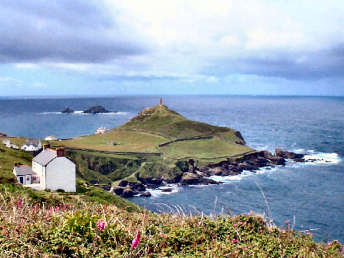
If you want to see the end of the world and enjoy rugged grandeur and the feeling that far over the horizon is America, forget much touted Land’s End:  the crowds and theme park will completely spoil its grandeur for you.  Instead go to Cape Cornwall by St. Just in Penwith, a mere five miles as the crow flies but spiritually a million miles away.  This may not be England's most westerly point - Land's End is - but until only a hundred or so years ago most people thought it was.  Follow the signs from St. Just village, park in the National Trust Car Park and use the National Trust West Penwith Booklet to explore the Cape and its environs, including Priest's Cove, Kenidjack Valley and the Cape itself, topped by a mine chimney.  Continue south beyond Priest's Cove and, close to the clifftop, you will find the remarkable Bollowal Barrow, a neolithic and bronze age burial chamber.
Refreshments at Cape Cornwall Golf Club, Britain's most westerly;  I strongly recommend the bacon and egg baps for great value.  Spend time in St. Just itself for the impressive church, several art and craft galleries and teashops and pubs.  We have enjoyed Cornish pasties at the pleasant but down-to-earth Star Inn and several shops sell a variety of good pasties. 
Cape Cornwall from Kenidjack Castle
OS Explorer Sheet 102        More images around Cape Cornwall
Return to The Far West
Return to Coast and Countryside
Return to Reviews Contents


More Images around Cape Cornwall
Bollowall Barrow, just south of Cape Cornwall
'St. Helen's Chapel', more likely an old farm building
Return to Cape Cornwall
Return to The Far West
Return to Coast and Countryside
Return to Reviews Contents


Priest's Cove at Cape Cornwall - A Feature
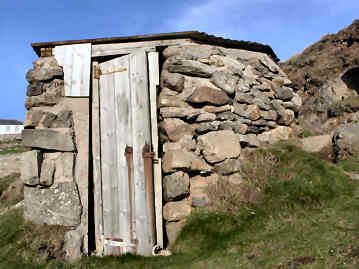
Tucked away from easy public view below the south flank of Cape Cornwall there is a remarkable survival, a tiny cove from which fishermen still scrape a living in small boats, harvesting crab and lobster and occasional hand-line mackerel.  Small boats are drawn up on a slippery ramp, tiny huts slot into the cliffs and mesembryantheum grows rampant on walls and even over the huts;  we had previously seen this on Scilly.  To the south of the cove are adits cut into the cliff for the former St. Just mine;  above the north side are the terraces of a lost garden, created by local man Francis Oats, son of a miner, who as a boy walked to Penzance each evening to attend classes and rose to become chairman of the De Beers diamond empire in South Africa.  His home, Porthledden House (under restoration in 2008) stands high above Cape Cornwall;  parts of his former walled garden can be seen at the top of the photo below left.

Boats and Fishermen's Huts at Priest's Cove
Fisherman's hut perched on the cliff
Return to The Far West
Return to Coast and Countryside
Return to Reviews Contents


Cape Cornwall to Sennen - One Way, taking the bus back

In November 2004 my sister Mary and I had a great walk from Cape Cornwall to Sennen, a mile or two short of Land's End.  We had seriously thought of doing the return walk to Cape Cornwall but had clearly underestimated how slow and difficult the one-way six miles would be - a lot of up and down and a lot of rock scrambling and avoidance of mine adits - and darkness would have overtaken us, the last thing you want on misty 300 foot cliffs.  Happily a little local bus does a circuit of West Penwith and our timing was good enough to get transported from Sennen Cove all the way back to the car park at Cape Cornwall.  As always with these coast path walks the scenery was superb with Cape Cornwall and Land's End in view most of the time.  We lingered near the start of the walk to inspect another of West Penwith's antiquities, this time the unusual clifftop Bollowal Barrow.  Publicity had led us to expect to like Sennen Cove.  The beach, Whitesand Bay, was lovely and surfers were out but the village is dull though we got good apple pie and coffee in the Old Success Inn.  We quite liked the look of The Beach café there and should try it next time we are there.
Fog descends on Whitesand Bay
OS Explorer Sheet 102
Return to The Far West
Return to Coast and Countryside
Return to Reviews Contents


Porth Nanven - a feature
Walking the coast path between Cape Cornwall and Sennen, it would be easy to pass Porth Nanven by.  It is worth seeing on two accounts.  First for its remarkable geologyin the two coves a wave-cut platform in the cliff shows where sea levels were once many feet higher;  ancient sea-worn boulders from above have tumbled to the modern beach and are now protected by law.  Second for the relics of ancient mining:  climbing the hill up to Hermon Cliff are the pylon bases of what may have been an aerial ropeway;  by the coast path on the cliff are many mine adits and old shafts;  at the foot of the cliff is an old mine building - and a 16th century wooden water pipe is now in Geevor Museum.
Remains of,  presumably, a mine-related building
Some of the remarkable rocks in the cove at Porth Nanven
Return to The Far West
Return to Coast and Countryside
Return to Reviews Contents


Sennen to Land's End - Out and Back from Sennen

Jane and I had previously walked from Porthgwarra to Land's End and Mary and I had walked from Cape Cornwall to Sennen Cove.  That left a small gap which I completed with this short walk - no more than a couple of miles each way - in September 2005.  It was a something of a dull and drizzly day, so about the only half decent photo I got was the one of the Irish Lady rock below Mayon Cliff. 
Sennen Cove itself is a disappointment.  Tourist publicity raves about it but, as fishing coves go, it has nothing on Penberth.  The Roundhouse and a couple of thatched cottages are attractive but little more.  The eastern extension of Sennen Cove village has little to commend it either though Whitesand Bay surfing beach is great and The Beach café looks like a good place, if a bit pricier than some. 
However, there is plenty of interest in the short walk to Land's End.  A stone-built former coast guard hut commands a fine view from Pedn-men-du Head.  A little further along, an almost hidden sign points to the scant remains of Maen Castle cliff fort - little more than the gateway - and, if you scramble down to the top of the cliff nearby, you get a good view of the remains of the Mulheim, wrecked in Castle Zawn in March 2003.  From Dr. Syntax's Head at Land's End are good views of Longships rocks and lighthouse. 
OS Explorer Sheet 102.  An easy walk. 
The Irish Lady rock below Mayon Cliff
Sennen Cove:  I was back there in the course of a 10 mile round walk from Land's End in April 2008.   This time it was warm and sunny and my impressions of Sennen Cove were a little more favourable.  I have posted a report on my Towns and Villages page.  I was also delighted to find that the Nationsl Trust has done a great clearance job on Maen Cliff Castle.
Return to The Far West
Return to Coast and Countryside
Return to Reviews Contents


Land's End and Porthgwarra - Out and Back from Porthgwarra

On the last day of October 2004, just a couple of weeks after our most enjoyable Porthcurno and Porthgwarra walk, and our visits to Minack Theatre and the Porthcurno Telegraph Museum, we decided to add to our (so far) few West Penwith walks and to visit Land's End on foot.  We parked at Porthgwarra where the coast path sign proclaimed 3¾ miles to Land's End.  However, if you hug the coast, it is at least 5 miles.  It is a truly wonderful walk with superb coastal views, towering rounded granite rock formations and a lot of variety.  On Gwennap Head there are two conical daymarks, one black and white, the other red.  We were amused to be invited up into the nearby coastwatch tower for a chat with the duty officer!  Just west, in Porth Loe Bay, part of the granite cliff has the look of a romanesque cathedral.  A little further is Mill Bay where the sands are silver and the housing of a former water-wheel stands just above the beach.  Finest view of all comes when you get to Carn Cheer and look across Enys Dodman (the isle with the hole) and the Armed Knight rock towards famed Longships Lighthouse, its constant foghorn high pitched and mournful.  From Land's End (Doctor Syntax's Head) you look north to Cape Cornwall.  Whatever you do, do not linger at Land's End, mainly an appalling theme park.  We returned by an inland route for a round walk of 8 or 9 miles. 
Jane looks over Enys Dodman, the Armed Knight and Longships
OS Explorer Sheet 102;  park at Porthgwarra 
Return to The Far West
Return to Coast and Countryside
Return to Reviews Contents


Porthgwarra, Gwennap Head and Porthcurno - Out and Back

In October 2004 Jane and I went primarily to visit a couple of attractions in Porthcurno - Minack Theatre and the Telegraph Museum - but decided to add in a walk as well.  We took the coast path from Porthcurno, by way of Pedn-Men-an-Mere Head, where we enjoyed our sandwiches looking over Porthcurno Bay.  On by Porth Chapel, location of  St. Levan's holy well and the remains of his baptistry and chapel.  On into Porthgwarra, a tiny village with a steep slipway up which the one remaining fisherman has to winch his boat.  The fisherman and his wife, the Chappells, also act as harbourmasters, shop keepers, café operators - and any other service the village needs, so it seems.  Just off the right of the picture is a passage cut through the granite;  above Jane's left shoulder are two caves cut into the rock.  Just past Porthgwarra, on the western side, stands Gwennap Head crowned by a couple of conical daymarks.  The time to go there is July when the short gorse and heather, barely three inches tall, are a riot of colour.  We made our way back inland by way of St. Levan village.  Here the church has a Norman font, part of a Tudor chancel screen, and some good medieval and contemporary bench ends.  Outside, a lych gate has coffin rest and benches but no roof.  There is a pub in Porthcurno, a seasonal café at Porthgwarra and parking at both ends. 
The steep slipway at Porthgwarra
Os Explorer 102;  variants in most walk guides 
Return to The Far West
Return to Coast and Countryside
Return to Reviews Contents


Porthcurno and Penberth Cove - Round Walk from Treen
On a sunny day in early December 2004 we parked in Treen and set out to walk to Penberth Cove and Porthcurno.  We managed to miss the footpath to Penberth (it runs from a corner of the car park) and did a mile more than planned, probably five miles in all.  National Trust-owned Penberth Fishing Cove is a delightful throw-back.  The coast path west from there to Porthcurno is difficult at each end but easy once up top.  Halfway there we detoured on to Treryn Dinas Head, site of a massive but overgrown iron age promontory fort.  The largest of three walls still stands to a height of 20 feet;  it would be good if the NT were to clear away the growth.    Right out on the headland is the most famous of the 'logan' (rocking) stones.  Just before Porthcurno, a pyramidal white landmark stands in the place of the cable-hut where the first transatlantic cable came ashore in 1858.  In the village is the superb Telegraph Museum.  We made our way back to Treen inland on a clearly defined path.  Had the walk not taken rather longer than expected, we would have stopped off in Treen at the Logan Rock Inn.  Another time perhaps.  Use the National Trust West Penwith leaflet or Classic Walks Cornwall.

The restored capstan winch in Penberth Cove
Porthcurno Bay from Treryn Dinas
Return to The Far West
Return to Coast and Countryside
Return to Reviews Contents


Penberth Cove and St. Loy's Cove - Round Walk from Treen

With Mary I had done a round walk that took in Lamorna and St. Loy's Cove.  With Jane I had done a round walk from Treen to Penberth Cove and Porthcurno.  To fill in the gap, in October 2005 I parked in Treen and did a round walk that took in Penberth Cove and St. Loy's Cove.  A glorious morning clouded over by noon but by then I had completed the coastal part and enjoyed the superb scenery at its best. 
Although several paths are signed out of Treen village, the one down to Penberth Cove is not but if you take a track along the west side of the car park you will find it. Penberth Cove is a delight and the path down easy.  The coast to St. Loy's Cove is moderate (though views are lovely) but the descent to and ascent from Porthguarnon is stiff with around 150 steps each way. 
From St. Loy's Cove I followed a path through woodland (with bamboo and hydrangeas) up to Trevedran, the road past Treverven, and a field path (unsigned) past Silena Farm (lovely old barn) back to the road just short of Treen.  Parking in Treen is inexpensive.  A shop by the car park does breakfasts and cream teas (but apparently not on Sundays).  The Logan Rock Inn is very much a local but its menu will appeal to walkers.
OS Explorer 102.  Mostly easy/moderate.  Wet in woods. 
Looking west over Porthguarnon to Cribba Head
Return to The Far West
Return to Coast and Countryside
Return to Reviews Contents


St. Loy's Cove and Lamorna - Round Walk from Lamorna Cove
A forecast rainy day in late December 2003 turned out much better than expected and this walk, not far from Land's End, turned out much better than Mary and I might have hoped.  We parked just above the water at Lamorna Cove and walked the coast path to St. Loy's Cove, then took a route inland up the Boskenna Valley, across country and then back down the Lamorna Valley to Lamorna Cove.  The coast part was by no means easy - severe rock scrambling at the start and in St. Loy's Cove - but views were glorious.  Amazingly, wild flowers were out and daffodils were already about to bloom.  Inland, we passed several antiquities:  Boskenna Cornish Cross, burial chamber remains and the Merry Maidens Stone Circle.  We lunched in Lamorna village at the Lamorna Wink Inn, a simple place with basic fare served very speedily.  The story is that Cornwall had many such 'Kiddlywinks', unlicenced ale-houses used as smugglers' dens, to which the authorities turned a blind eye or 'winked'. 
Lamorna Cove
Massive rocks on the beach at St. Loy's Cove
Return to The Far West
Return to Coast and Countryside
Return to Reviews Contents


Lamorna Cove and Mousehole - Round Walk from Mousehole

My first walk of April 2005 was planned as an easy one after a dose of flu had left me a bit weak.  I drove to Mousehole (best visited out of season when less crowded) and parked above the harbour.  I followed a walk from Classic Walks Cornwall, Vol 1 number 5.  It looked complicated but turned out straightforward.  I made one change.  Where Classic Walks would get straight on to the inland return path, I chose to walk the half-mile up the lane from the cove to the Lamorna Wink Inn to pick up the path from a different direction.  I was glad I did because there are some lovely cottages and an abandoned watermill in Lamorna village that otherwise I would have missed. 
The coast path part of the walk was a bit disappointing.  While I was drenched in sun, mist hung out to sea so the hoped for view over Mount's Bay to the Lizard, never materialised.  Wild daffodils along the path made up for that.  To my surprise, the inland section was the most entertaining.  After leaving Lamorna village I went through a succession of daffodil meadows, then through four ancient farming hamlets, each different.  At Kemyel Drea stiles take you right through the farmyard! 
Eat at the Lamorna Wink or the Ship Inn in Mousehole.  There's more parking in Mousehole and free parking on the road from Newlyn.
View of Mousehole from Raginnis Hill
On OS Explorer 102.  Six moderate miles. 
Return to The Far West
Return to Coast and Countryside
Return to Reviews Contents


Mousehole to Penzance via Newlyn

This is technically part of the coast path - but among the most urban parts.  You walk along the seafront all the way but you are first in Mousehole, after a short break you are in the housing in Newlyn and finally in Penzance.  For an urban walk it is an entertaining one.  You first follow the road from Mousehole's charming small harbour, with open views over Mounts Bay to St.Michael's Mount.    As you come into Penzance, soon you encounter handsome terraces of small 18th century houses, then you pass the former National Lifeboat Museum before coming to the harbour. A pleasant three miles with regular buses for the return.  Photographs are:  Above a panorama of Newlyn Harbour;  left Stevenson's fish shop in Newlyn; right a pastiche of a Stanhope Forbes painting above a Newlyn restaurant. 
Return to The Far West
Return to Coast and Countryside
Return to Reviews Contents
REVIEWS INDEX and SITE CONTENTS
Recent Reviews
Homes
Gardens
Museums & Galleries
Coast & Country
Holy Sites & Churches
Antiquities
Castles
Towns & Villages
Miscellanea
Pubs
Scilly
Devon
Introductory Guide
Home Page
Contact Me
© Copyright Oliver Howes 2088 
Return to main Coast Page
Page updated 29 Febuary 2008


Free Web Counter